Showing posts with label Fear. Show all posts

Tuesday, September 23, 2008

Greetings From The Byzantine Route


Sunday morning in Paros incense tastes like sweet chalk on my tongue. Myrrh, I think, I am not certain. It is burning fresh in all the small churches throughout the town and the odor falls thick into my mouth.
Seven thirty in the morning church bells call everyone in. I am awake anyway. Sunday is different than the other days, people rest. You can feel the energy settling everywhere.
Smells like Paros... honey, food cooking – grilled meats, garlic, something very sweet, tomatoes. Honeysuckle, but only in the morning. Cigarette smoke doesn’t really bother me, to my surprise.
Sometimes thick diesel fuel and oil, they don’t linger long, carried out to sea with the wind.
On the waterfront, odors of fish, seaweed and wet wood are stronger.
On one particular Sunday basil bouquets were given out at church coating the streets of Parikia with the scent. In addition to kissing the glass encased photos of the saints in alters of the Panagia Ekatonadapyliani Church, the people wave herbal bouquets over each sacred icon. It is a lot of work, a lot of attention. People, other than me know what to do; I feel like a voyeur.

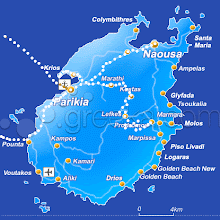
Bus tickets to Lefkes are available in the mini-market. In Prodromos, at the bakery. In Naousa you pick them up at the newsstand with the red awning around the corner from the main square. You have to know it already or you must ask to find out; the rare signs in English are sometimes hidden and written in small letters. The Greek word for bus stop is easy to spot now.

Things make sense in Greece when one is patient and waits for the big picture to reveal itself. Things do not make sense when we are impatient, filled with expectation. It is simple.
There is a remedy for confusion about situations, just shrug your shoulders and give it over to fate. Why? is unimportant - so much of the time. Things just are the way they are and need little explanation, it fits. There is a lot of acceptance for certain things here.
Many would agree, not just Greeks.

The other day I told a few people I had not slept the night before and found out none of them had either. Interesting, so we all thought; energy is so easily shared on the island. It was in the air, we speculated, needing nothing more than that to appease us. There is no point in creating reasonable reasons for answerless questions. False satisfaction does not play well here.
It is a half hour bus ride from Parikia to Lefkes which is located in the middle of the island and on top of a mountain. The bus cuts inward away from the sea. Many Germans are on this ride with me, I understand more of their conversations than I would have quessed.
The Greek man is snoring but no one bothers him or even laughs. I sneak a photograph though, and hope no one is watching.

Christina told me about the Byzantine Route from Lefkes to Marpissa on the east of the island. She said I can walk the path down and then take the bus back around to Parikia in the west. She left out the length of the trail. Six kilometers feels like fifty miles wearing New York style flip-flops on rocky, uncertain terrain. Unprepared with the footwear, I am still reliable in many ways. Midday hot; I like it.

Like so many other towns here, Lefkes has a main street for vehicles to drive along and the winding, turning paths lined with homes are all pedestrian-only walkways. Houses are built up the side of the hill, into crevices, into the countryside. Sinuous ramped stone streets break into unexpected turns. I get mixed up and find myself passing by the same homes, stores, cats, several times before finding the route again.

The man kicking the fig down the street smiles at me. Signs are posted sporadically; maybe it is the same sign I saw before. Pristine whitewashed houses abut long ago deserted homes with broken roofs where birds now take up residence. As I come closer I hear the nervous flutter of winds inside.

The Byzantine Route starts in the village of Lefkes and finishes down the mountain. No living civilization after I leave the town until Prodromos six kilometers later. The route continues after Prodromos to Marpissa and Marmara, by then the terrain is relatively flat.

I keep following the signs through the village which eventually open up to the path proper. A dirt road flanked by stone walls on either side leading out into the hillside and far away from Lefkes.

Proud enough to have found it, I think nothing of starting out. Without the Scarecrow or Toto, I am reciting my numbers in Greek for practice. I can make it to forty-nine now without a problem. Still using time wisely.

It is an hour into the route and the village of Lefkes is long gone now. Not a soul on this road except these four French travelers headed up while I am headed down.

They are panting when we meet because of the steep uphill climb. We exchange information about how far we’ve come from in either direction. They tell me twenty minutes more for me before Prodromos. I point to my feet to show them the insufficient footwear instead of regulation hiking shoes each of them is sporting. I should be grateful that this flimsy pieces of rubber have lasted this long. The man changes his estimation for me to forty minutes to the town. When I explain my foolishness for wearing these shoes he says, "Because you are young, so it will be okay."
I consider moving to Paris to live with them forever as I watch the quartet leave me to continue up the hill to Lefkes.

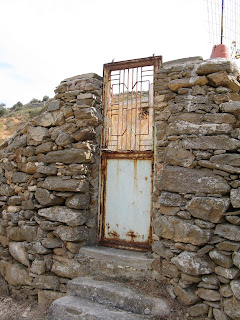
It is all ruins of ancient stone buildings that had been abandoned long ago and a path that has been trod on for thousands of years. For some stretches, stone walls flank each side of the path. Every piece of slate was carried up individually and laid down specifically; so much of it remains. There is determination here; silence and space.

It is hard to look up when you are going down the Byzantine Route. Jagged rocks require attention and sticks poke out from holes in the stone walls. It is difficult but not impossible to keep looking up ahead and towards the sky.
More than an hour since meeting my French friends and having them miscalculate the remainder of my hike. Flip-flops are still holding up, no small miracle. At least I wore long pants instead of that short skirt I considered this morning because of the heat that was expected today. Dehydrated brambles and bushes would whip my bare thighs and cause me to carry home fresh wounds from this trek.
I crest over yet another hill and see Prodromos, like Valhalla, in the distance. Behind her, the sea and my old friend, Naxos rising in the distance.

Arriving in the town is uneventful despite having made it in these shoes. Prodromos is observing afternoon siesta and no one is around. Three cats sunbathing in the road almost look at me; the calico opens his left eye when I come close but then returns to napping. And the goats, they never stop chewing. Dogs, as usual, asleep in the shade.

The woman in the gas station tells me to buy my bus ticket at the bakery, so I act like I know something. I am going to miss the sunset in Parikia, I think, waiting for the bus with an old man who is crouching and staring at me while I write in my book. I am finding it hard to concentrate with him focused on me.
I would not have thought I had the courage to hike a long trail like this alone. I had convinced myself long ago that silence and isolation in remote places are adversaries. There is plenty of solitude on the Byzantine Route, but no fear. Not even a mosquito to worry about.
Saturday, September 20, 2008

No Fear In Paros

It is raining in Paros.


We had been expecting it. The sky is a slate grey wall matching the grey of the sidewalk pavement.
Saturday, one twenty in the afternoon. Church bells ringing slow and somber because someone has died. They sound bottomless and important. A nearby gong…then the echo… pause… gong… echo again… silence. In the distance the same sound only far away. It may be that I hear chanting too, I’m not sure. This goes on for five minutes, maybe more.

The sound of the gentle rain drops falling through the Bougainvillea tree leaves outside my veranda and landing on the street below. Footsteps of people walking faster than usual to avoid getting wet. The sweet, soft music Christina plays in the courtyard of the hotel in the afternoons and evenings.


We have been expecting the rain. It is the first rain in five months. On the beaches a trench has been dug to pull the runoff from the streets into the sea. People have to think like that here or businesses will be destroyed.

A stone channel runs through the streets to move the water. When it rains very hard or very long the ditch does little to help. Every once in awhile rain comes and there is a lot of damage. Businesses, especially the cafes close down when it rains, they rely on the outdoor traffic. People take a day off; they invite friends over, have barbecues, make parties.

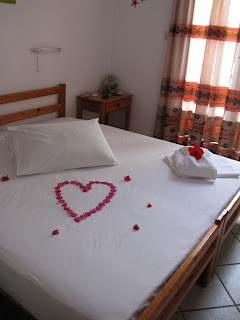
This morning Christina left flower petals in the shape of a heart on my bed.

When I thanked her she said, "It is nothing, not at all."
She’s wrong, it is something.

Yesterday, Peter offered me a lift.
"Let’s go for a ride, I’ll give you a tour."
We get on his motorbike. The one he bought the day before.
"I won’t go fast." Peter says.
"I’m not afraid." I tell him, tucking my short skirt under by ass so it does not fly up and reveal my behind on the ride.
"It’s not that. You can’t go fast in Paros."

We take off up the road towards Magaya Beach, Pounta, and points south.

Wind whipping my face feels good.

Earlier this week, I wrote in my journal that a ride on a motor bike around this island would be perfect.
I was sorry I had not gotten my international driver’s license after all.
Oh, well, too bad, probably better this way anyhow, I’d just get into trouble riding a bike out here.

Later I will tell Peter: I wished for it, let it go and it happened anyway.

"Paros is built on a block of marble, so there is a lot of stability here." Peter yells back to me as we are driving.
I think of Santorini, built on top of a volcano, and understand why I felt out of sorts there.

Perhaps that’s why there are so many artists living here, and ex-patriots? Paros satisfies wanderlust while also providing safe ground to rest on.
I tell Peter that I feel very creative here.

There is a palpable sense of freedom. Maybe people feel creative in Paros because they have the stability underneath them, a strong foundation under their feet; while on top there is a vastness that frees them to play and be expressive.
It’s about safety again.

I do feel safe here. Safe and creative, grounded and free.

Open.

It is late in the afternoon at Magaya Beach, Peter is ready to go. We are driving in the opposite direction of Parikia. Maybe a shortcut? He drives down to the port in Pounta and right up onto the waiting ferry in the dock.
Later he will tell me that he knew if the ferry had not been there ready for us I would have given him a fight about going to Antiparos for dinner.
He was right, I would have.

"For what? You have something you have to do instead? And anyway, I wanted to go to Antiparos one more time before it closes down completely."

Peter connects people to each other; he introduces people and shows them who their friends might be. Peter seems happy, he understands joy, he knows about the things that matter.

"Koritsaki." He calls me. Little Girl. Some people I know back in The States would find that interesting, amusing. I like it.

Earlier today, in Magaya, he ordered a plate of smoked pork, something special, because he knew we should try it.

Antiparos is a ten minute ferry ride from Paros. It is a tiny, magical island, distinct from Paros.
Much of Paros shuts down after the summer season, while almost the whole of Antiparos closes. Many of the bars and restaurants have already closed up for winter; some have only a few weeks left before they too will shut down until April. It’s quiet here, whispering silent, like a secret.

I am enveloped by the warmth of the island me as soon as we arrive. It is as if the breeze is made of long arms reaching out and pulling me in. It is just after siesta so the children are all out again running through the streets with renewed enthusiasm. Restaurants and shops are reopening. We are sitting in a café on the main street drinking wine; it is a pedestrian only walkway like so many in the Cyclades. No cars to be afraid of all the time, it makes a difference in how children play.


Peter overhears some people at the next table say in Greek, "Thetiki eneryia."


"It means, positive energy – that is Antiparos."


We reminisce about the day I first walked into the café. Peter says he liked me because I ordered a glass of red wine and then logged on to the computer to communicate with my people back home. Not rushing, relaxing.
He tells me he saw me smiling at the screen and thought that was good.

I think, sometimes people are watching out for us though we don’t know it.

Sunday, September 7, 2008

Captain Miltos


“You are frightened now, Elizabeth?” Miltos asks me.

Yes, I am frightened now. I tell him the truth which makes him laugh. The wake rushes behind him as he steers us out into the bay. Waves are breaking against the side of the boat. The mood is uncertain. It is eight in the morning and he seems less surprised to see me than I am to be here. Sleepy Adamas Port is disappearing behind a cliff corner; there is no one else out on the water this morning, and this is not a dream.

It was when we were drinking shots of ouzo on his boat last night at the dock that he reminded me of his offer from several days before and asked me again to join him in the morning for fishing and lunch on the boat.

“I will show you how to fish.” Miltos tells me after he finishes tying lines to drop in the water for the next day. He is smoking his pipe and we are drinking out of two shot glasses he borrowed from Marinella’s Taverna across the way. I am considering the proposition and how to choose it. The church bells sound off nine o’clock in the evening, I am hungry and the ouzo is working on me.

I thank him in Greek when he pours me another shot of ouzo. He tells me you are not supposed to thank Greeks when you drink.
“Yia mas!” Miltos insists, “Because if we were sitting in a bar drinking all night and you thanked me every time I poured you a drink we would not have time to talk about anything else.”

He tells me he is crazy and from the moon and that he never wears shoes. I believe him because he also tells me that he is very kind and I can see this truth.
There is a commotion with a woman on the path. Miltos grabs a long rod from the floor and uses my shoulder to balance himself as he jumps from the boat. He fishes the lady’s pink hat from the water. She bows and thanks him again and again.
“I am a good neighbor.” He tells me when he returns.

Our conversation is interrupted by the passersby wishing him good evening, and the boy who has a lot of questions about the sea, and the other man who wants Miltos to take him fishing.
I say he seems to know so many people in this town. He tells me they know him; which is different. His eyes shine and he tilts his head to the right when he smiles from behind his thick black beard and mustache.
“Life is too short, you must make many short plans. Tell them Captain Miltos taught you that.”

He asks me again to meet him in the morning to go fishing. The ouzo is making me light headed, I do not make any promises.

“I might be here at six tomorrow morning,” He tells me, “And I might be here at seven but I will definitely be here at eight, we will go then.”

I did not sleep well during the night.

Miltos tells me the boat is five meters long and thirty-six years old. He is standing in the hole at the back from which he steers. The sun rays look like stars on the water. He asks me if I am okay and I tell him I am.


The sea is rough in the middle of the bay but calms when we get to the other side. Miltos gives me a line and instructs me to hold it out into the water like he does, pulling at it gently trying to lure the fish in.
“Anything?” he asks, referring to my line, “Anything yet?”
“No.”
“Not yet. But soon.” Miltos says, “We have time, and we have dessert.”

The fish are not biting so we pull in our lines and go into a cove and try for octopus. Octopus lure is made of four small fish tied to a foot long link of chain. Miltos slows the boat and drops the line into the water and we wait. He tells me that when he catches an octopus he pulls it out of the water and holds it up by its neck and he says,
“Tell me, where are the others?”
When the octopus does not confess he kills it by slamming it against the side of the boat. He says he will teach me how to do it.
I tell him I am not a torturer or a killer.
“Okay,” he says, “I will do all the killing.”


We motor in and out of the coves and I am laughing a big laugh.
White goats graze at shore. Miltos says there are sometimes seals in this area.
“Fucking seals! They put holes in my nets.”

There is no one out on the sea with us. Not another boat, not anything or anyone. I think maybe I am strong enought to swim to shore, but what would I do after that. I tell him that maybe it is my fault the octopus are not biting today. I think I could be bad luck. Miltos says he is sure I am good luck. He starts the boat up again and takes us to church.

The tiny church is up a hill inside a hidden cove. There are no roads leading to the church, the only way to it is an approach by sea.


We dock the boat on the tiny pier and walk barefoot up the short rocky road. Miltos opens the iron slide bolt of the small door and cool air from inside blows out onto my face. There is a small step up into the church and we must bend in half to enter through the short door. A kerosene light is burning in the center alter. An elaborately carved confessional stands at the back with deep blue velvet drapes covering the windows. On the chalk white walls bright paintings of Greek saints with golden halos hang in wood frames. There is no ouzo in the alter cabinets.
Outside, Miltos rings the bell to show me how it works and we look across the bay at the fishing village of Klima down by the sea and the town of Plaka above it on the hilltop.

Miltos has brought us a lunch of fresh tomatoes and bread. We rip pieces of bread from the loaf. He washes the tomatoes in the sea water to make them salty and we take bites from them as if they were apples. He offers me water but does not tell me he had mixed it with ouzo. He laughs at me when I take a sip. I refuse the shot glass he pours for me and decline a sip from the bigger bottle that he promises is pure water. He remarks that I have stopped trusting him.

In the center of the bay the waves get rough again.
“Are you still frightened now, Elizabeth?”
I tell him I am not frightened. Miltos laughs and drives the boat faster.